If you own a home in Poway built between the 1970s and 1990s, your pipes have likely been working hard for four or five decades. Many of those homes came with copper or galvanized steel pipes that were never designed to last forever. Add in San Diego County’s notoriously hard water supply, and the wear accumulates faster than most homeowners expect.
This guide covers everything Poway homeowners need to know about repiping: why local homes need it more frequently than you might think, what the most common repipe scenarios look like, how the county permit process works, and how to choose the right contractor.
Why Poway Homes Need Repiping More Often Than You’d Expect
Poway’s water comes primarily from the Colorado River through the San Diego County Water Authority’s delivery system. That water carries a significant mineral load. According to USGS water hardness classifications, water above 180 mg/L is considered “very hard.” Water in the 92064 and 92074 ZIP codes routinely tests in the 250–300 mg/L range — well into that category.
Hard water deposits calcium and magnesium carbonate on the interior walls of copper pipes over time. The buildup narrows the pipe diameter, reduces water pressure, and accelerates pinhole corrosion from the inside out. This is exactly why Poway homes from the 1970s and 1980s — many located in established neighborhoods like Twin Peaks, Midland Road corridor, and the Garden Road area — show pipe failure at rates higher than newer construction.
For more context on what drives pipe deterioration in San Diego County, the San Diego County Water Authority’s water quality page details the mineral content and source blending that defines the local supply throughout the year.
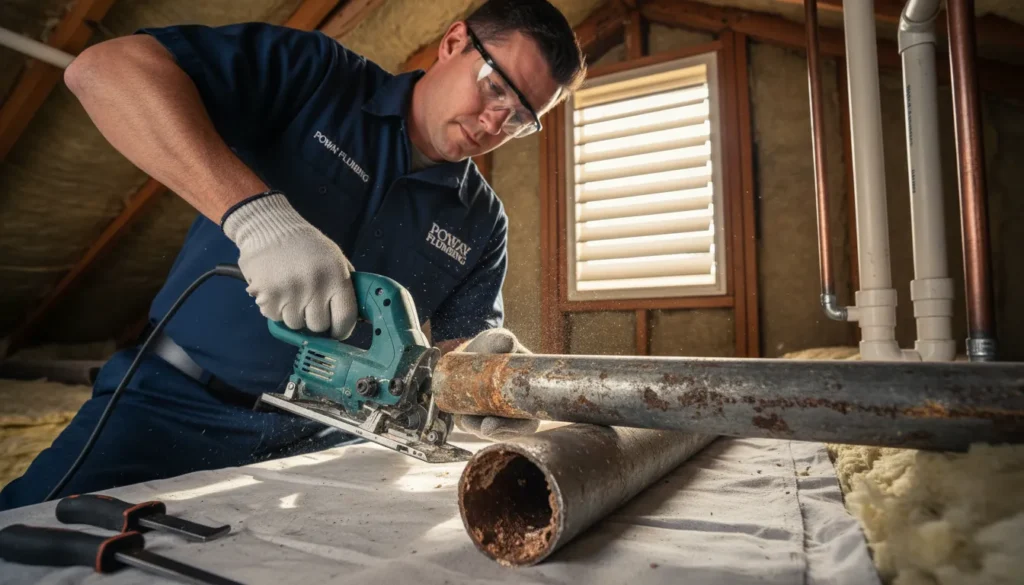
Galvanized steel pipes face a separate but equally serious problem. The zinc coating that protects the steel gradually wears away in hard water conditions, leaving exposed iron that rusts and flakes. Homeowners in older Poway neighborhoods often notice rust-colored water from faucets that have sat unused, reduced flow at fixtures, and eventually pinhole leaks or full pipe breaks. When galvanized pipes start to fail, they tend to fail throughout the system — not just in one spot. If you have noticed these warning signs, our why repipe page walks through the full list of indicators.
The Most Common Repipe Scenarios in Poway Homes

Polybutylene Pipe Replacement
A significant number of Poway homes built between 1978 and 1995 contain polybutylene (PB) pipes. This gray plastic material was widely installed across Southern California before research linked it to high failure rates when exposed to chlorinated water. If your home was built during that window and you have never replaced the plumbing, a licensed plumber should inspect it. Many homeowners in Rancho Bernardo adjacent areas and eastern Poway discover PB pipe only when they pull a permit for a remodel. Our residential plumbing services page includes details on evaluation and full-system replacement.
Copper Pinhole Leaks
Copper pipe installed in the 1970s and 1980s is often M-type copper, which has thinner walls than today’s L-type copper. Decades of hard water exposure cause pinhole leaks that appear first in hot water lines — the heat accelerates mineral scaling and localized corrosion. A single pinhole leak is often a signal that multiple spots in the system are close to failing. Repairing individual leaks while leaving aging copper in place tends to result in repeated service calls over the following months. If a leak has already occurred, our pipe burst repair service addresses the immediate damage while we evaluate the full system.
Galvanized Corrosion Throughout the System
Older Poway properties — particularly those in the historic areas near Old Poway Park and along Espola Road — sometimes still carry original galvanized supply lines. These pipes were common before the 1960s and early 1970s and are well past their expected service life. Full replacement with copper or PEX is almost always the right call. Partial repairs rarely hold because the surrounding pipe is equally compromised. In some cases, a pipe reroute may be the most practical approach depending on the home’s layout.
Understanding the Poway Permit Process for Repiping
Any whole-house repipe in Poway requires a permit through the City of Poway’s Development Services Department. This is not optional — unpermitted plumbing work can create problems when you sell the home and may void homeowner’s insurance claims related to water damage.
Here is what the permit process generally looks like for homeowners:
- Your licensed plumber pulls the permit. A C-36 licensed contractor submits the permit application on your behalf, including the scope of work and materials to be used.
- Work begins after permit issuance. The permit is typically issued within a few business days for standard residential repiping projects.
- Rough-in inspection. Once the new pipes are installed but before drywall is patched, the City of Poway requires a rough-in inspection. The inspector verifies that pipe sizing, materials, and installation methods meet the California Plumbing Code.
- Final inspection. After drywall patching and restoration, a final inspection closes out the permit.
A reputable contractor manages this process for you. If a contractor quotes a repipe job and does not mention pulling a permit, that is a significant red flag.
Copper vs. PEX: Which Is Right for Your Poway Home?

Both copper and PEX are excellent options for a whole-house repipe. The choice comes down to your priorities.
Copper repiping produces rigid, long-lasting joints that many homeowners and inspectors prefer. Copper L-type pipe has thicker walls than the older M-type copper that may already be in your home. It resists UV exposure, rodent damage, and most chemical reactions in the water supply. The trade-off is a higher upfront cost and a project timeline that typically runs one to two days longer than PEX.
PEX repiping uses flexible cross-linked polyethylene tubing that threads through walls with fewer penetrations, reducing drywall repair time and cost. PEX handles hard water conditions well and is highly resistant to mineral buildup. The installation is faster, which can lower labor costs. For most enclosed interior Poway homes, PEX’s limitations around UV exposure and rodent activity rarely apply.
For a full side-by-side comparison and help deciding which is right for your home, visit our whole-house repipe service page. You can also review our FAQ page for answers to the most common questions homeowners ask before scheduling a repipe.
How to Choose a Repiping Contractor in Poway
The right contractor makes a repipe project straightforward. The wrong one turns it into a prolonged headache. Here is what to verify before signing anything.
C-36 Plumbing Contractor License
California requires a C-36 license for plumbing work of this scope. The California Contractors State License Board (CSLB) defines the C-36 classification as covering the full scope of water supply and waste disposal plumbing in all structures. You can verify any contractor’s license status at the CSLB website. An unlicensed contractor cannot legally pull a permit, which means no inspection — and no inspection means you assume all the liability.
Repipe Home Hero holds California C-36 Plumbing Contractor License #1075463.
Insurance
Verify that the contractor carries both general liability insurance and workers’ compensation. If a worker is injured in your home and the contractor has no workers’ comp, you could be held liable.
No Subcontractors
Some repiping companies win the job, then hand the work to a subcontractor you have never met. This creates accountability gaps and quality inconsistency. Ask directly whether the crew that shows up is employed by the company.
At Repipe Home Hero, Stefan and his own crew handle every project. No subcontractors. No exceptions. Read our story and approach on our about page.
Local Reviews with Specific Detail
Look for Google reviews that describe the project, the crew’s behavior, the quality of drywall patching, and how the home was left after the job. Generic five-star reviews tell you less than a detailed account from a homeowner who went through a full repipe.
Repipe Home Hero has earned 250+ five-star Google reviews across 1000+ completed projects throughout San Diego County, including Poway, Carmel Mountain Ranch, Rancho Bernardo, and Rancho Penasquitos.
Signs Your Poway Home May Need Repiping Now
Not every situation requires immediate action, but the following signs suggest you should have a licensed plumber evaluate your system soon:
- Water pressure has dropped gradually at multiple fixtures, not just one
- You see rust-colored or discolored water when you first open a faucet
- You have had two or more pinhole leaks repaired in the past two years
- Your home was built before 1985 and the plumbing has never been replaced
- You notice water stains on walls or ceilings without a clear source
- A recent home inspection flagged the pipe material or condition

Any of these conditions warrants a professional inspection. If a leak is active right now, our emergency plumbing service is available for immediate response across Poway and surrounding communities. Catching a failing system before it causes water damage saves thousands of dollars in restoration costs. While you are evaluating the plumbing, it is also worth considering whether a pressure regulator installation or a whole-house water filter would protect the new pipe system from the hard water conditions that contributed to the original pipe failure.
Get a Free Repipe Estimate in Poway
Repipe Home Hero serves Poway, Carmel Mountain Ranch, Rancho Bernardo, Rancho Penasquitos, and communities throughout San Diego County. We are a family-owned, C-36 licensed plumbing company with no subcontractors and a track record of completed projects you can read about from real customers.
Request a free estimate for repiping services in Poway or call us at (619) 386-0375. We pull the permits, handle the inspections, and patch the drywall. You keep living your life.
Also serving nearby: Solana Beach | Escondido | Vista | San Marcos | La Jolla | Carlsbad