San Diego homeowners drink, cook, and bathe with water that travels hundreds of miles before it reaches their taps. That water arrives treated with chloramines, carrying hard mineral loads, and sometimes delivering bursts of sediment during seasonal supply changes. A whole house water filtration system addresses these issues at the point where water enters your home — before it touches a single faucet, showerhead, appliance, or pipe.
This guide explains San Diego’s specific water challenges, the types of whole house filters available, the difference between point-of-entry and point-of-use systems, what professional installation involves, what it costs, and how to maintain your system year after year.
San Diego’s Water Quality Challenges
San Diego imports more than 80% of its water from two sources: the Colorado River and the California State Water Project (Sacramento-San Joaquin Delta). The San Diego County Water Authority treats and distributes this water across the county. Understanding what comes out of treatment helps you choose the right filtration approach for your home.
Chloramines
Unlike many water utilities that use free chlorine for disinfection, the City of San Diego uses chloramines — a combination of chlorine and ammonia. According to the EPA’s overview of chloramines in drinking water, chloramines are more stable than free chlorine and provide longer-lasting disinfection as water moves through distribution pipes to consumers. That stability is also why chloramines are harder to remove at the tap — they require catalytic carbon block filters rather than standard activated carbon.
Carbon block filters designed for chlorine-treated water often fail to address chloramine taste and odor because the wrong filter media was used. The EPA sets a maximum residual disinfectant level for chloramines at 4 mg/L. San Diego’s water typically runs at 1–2 mg/L, within legal limits, but enough to affect the taste and smell of water throughout your home and to accelerate degradation of rubber seals in appliances.
Hard Water and High TDS
Water hardness in San Diego County ranges from approximately 200 to over 350 mg/L depending on your neighborhood, the current supply blend, and the time of year. The City of San Diego’s annual Drinking Water Quality Report provides detailed data on local water composition updated each year. The Colorado River supply runs harder than State Project water, so hardness levels fluctuate seasonally as the county adjusts its supply mix.
Hard water deposits scale inside pipes, water heaters, dishwashers, washing machines, and coffee makers. It shortens appliance life, leaves residue on fixtures and glassware, and makes skin and hair feel rough after bathing. If your home has recently received a copper repipe or whole-house repipe, hard water will begin attacking the new pipes from day one without a filtration or conditioning system in place.
Seasonal Sediment
San Diego’s water supply blending changes throughout the year. During transitions between supply sources, brief increases in sediment and turbidity can occur. Sediment causes cloudy water, clogs aerators and showerheads, and damages appliance inlet valves. A sediment pre-filter is the most cost-effective front-line defense. You can read more about the role sediment filtration plays in San Diego’s water profile in our blog post on sediment filtration in San Diego.
Types of Whole House Water Filters
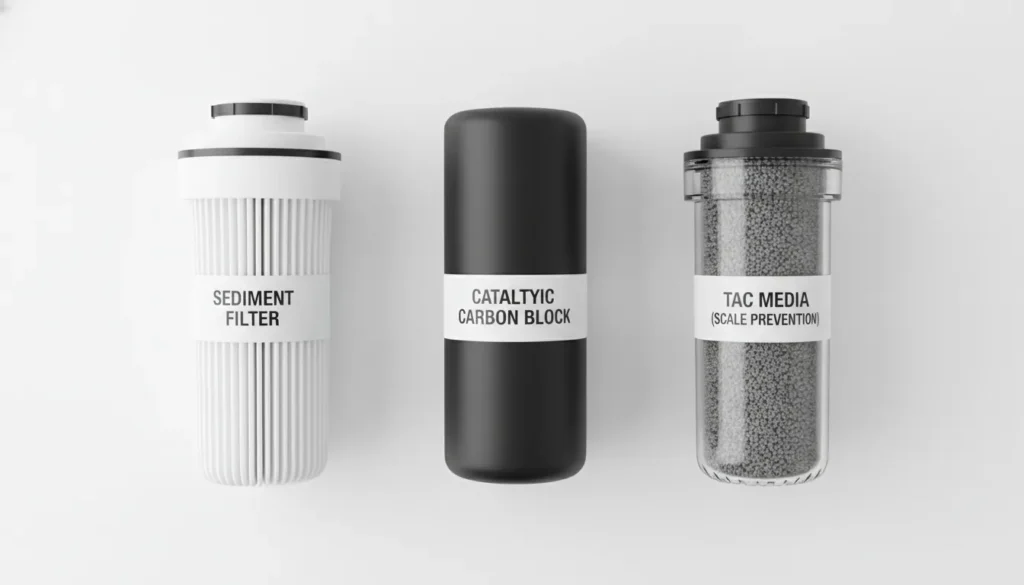
Not every filtration system addresses every problem. Matching the system to your water is the right approach.
Sediment Pre-Filters
A sediment filter is typically the first stage in any whole house system. It captures particles — sand, rust, dirt, and debris — before they reach downstream filtration stages or appliances. Standard residential sediment filters measure five microns. A one-micron filter catches finer particles but requires more frequent replacement. Sediment filters alone do not address chloramines, hardness, or chemical contaminants.
Best for: Homes with visible particulate matter, older pipes that shed rust, or well water. Also essential as a pre-filter stage before any carbon or softening system. Our dedicated water filtration system installation page covers all available system types and configurations.
Carbon Block Filters (Chloramine Removal)
Catalytic activated carbon block filters are specifically engineered to address chloramines. Catalytic carbon has a modified surface structure that breaks the chloramine bond — something standard granular activated carbon (GAC) cannot do reliably. Carbon block filters also reduce volatile organic compounds (VOCs), certain pesticides, and some heavy metals.
Best for: San Diego city water users concerned about chloramine taste, odor, and long-term effects on appliances and rubber seals.
Salt-Free Conditioners (Scale Prevention)
Salt-free systems use a process called template-assisted crystallization (TAC) or similar technology to convert dissolved calcium and magnesium into microscopic crystals that pass through pipes and appliances without adhering to surfaces. This is not traditional water softening — the minerals remain in the water, but they no longer form scale.
Salt-free conditioners require no regeneration, no backwashing, and no salt. They produce zero wastewater. Many California municipalities, including those in San Diego County, restrict or ban traditional salt-based water softeners due to the sodium they discharge into the wastewater system. A salt-free conditioner is the legally compliant path to scale protection in San Diego.
Best for: San Diego homeowners who want scale protection without salt, without discharge restrictions, and without ongoing maintenance of a brine tank.
Combination Whole House Systems
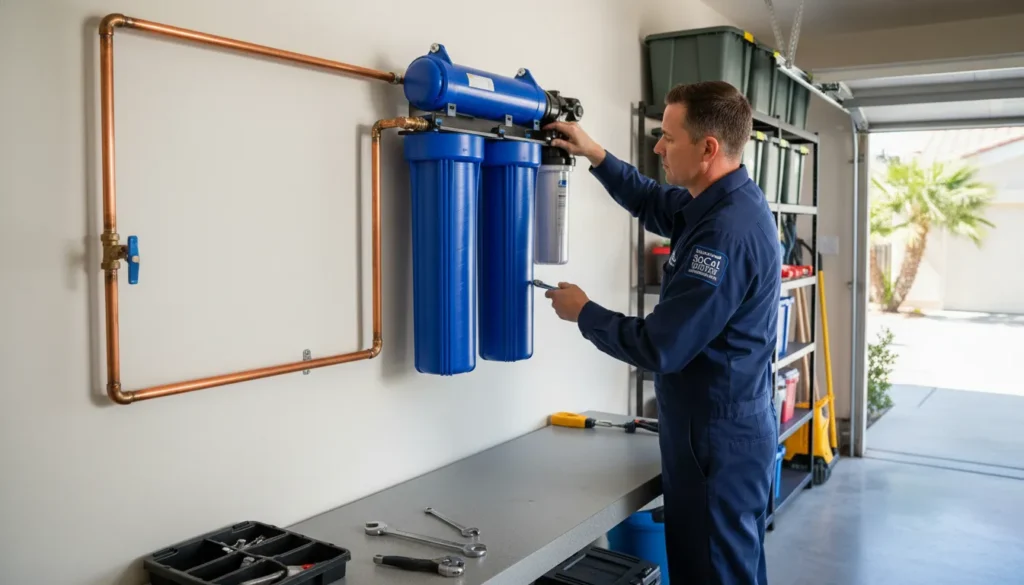
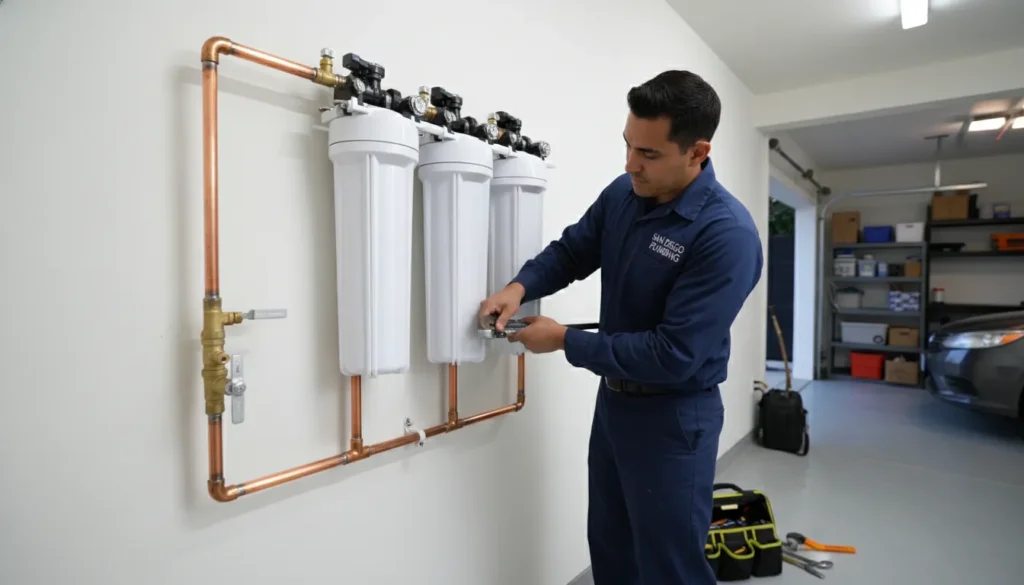
The most effective approach for San Diego combines multiple stages in a single point-of-entry installation: a sediment pre-filter, a catalytic carbon block stage for chloramine removal, and a salt-free conditioner for scale protection. These combination systems address the full range of San Diego’s water challenges in one installation.
Some homeowners add a reverse osmosis system at the kitchen sink as a final polishing stage for drinking and cooking water. This is a logical pairing: the whole house system protects pipes and appliances throughout the home, while the RO system delivers the highest quality water at the point where you consume it. We cover this comparison in detail in our blog post on reverse osmosis vs. whole house water filtration in San Diego.
Point-of-Entry vs. Point-of-Use: Which Do You Need?
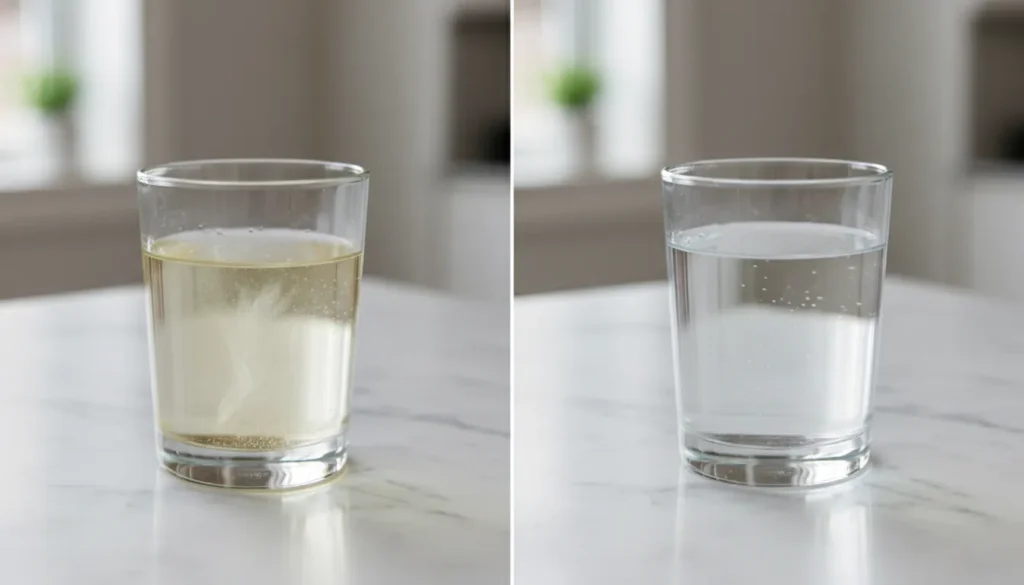
These two terms describe where filtration happens in your home’s plumbing system.
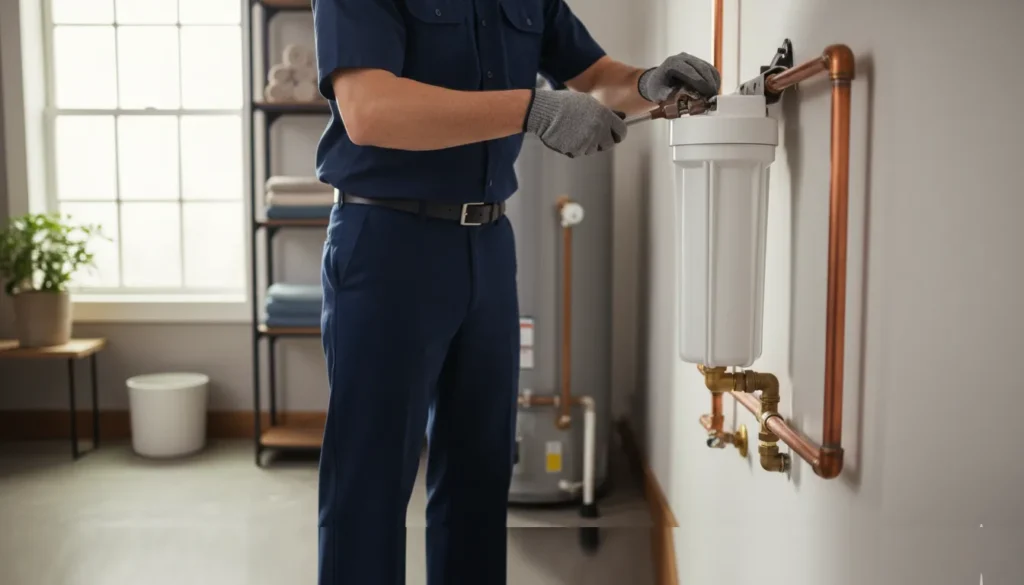
Point-of-entry (POE) systems install on the main water line where it enters the home — typically in the garage, utility room, or near the water heater. Every drop of water that reaches any fixture, appliance, shower, or faucet in the house passes through the filter. POE systems protect your pipes, appliances, and water heater in addition to the water you consume. Learn more about the full installation process on our whole house water filter installation service page.
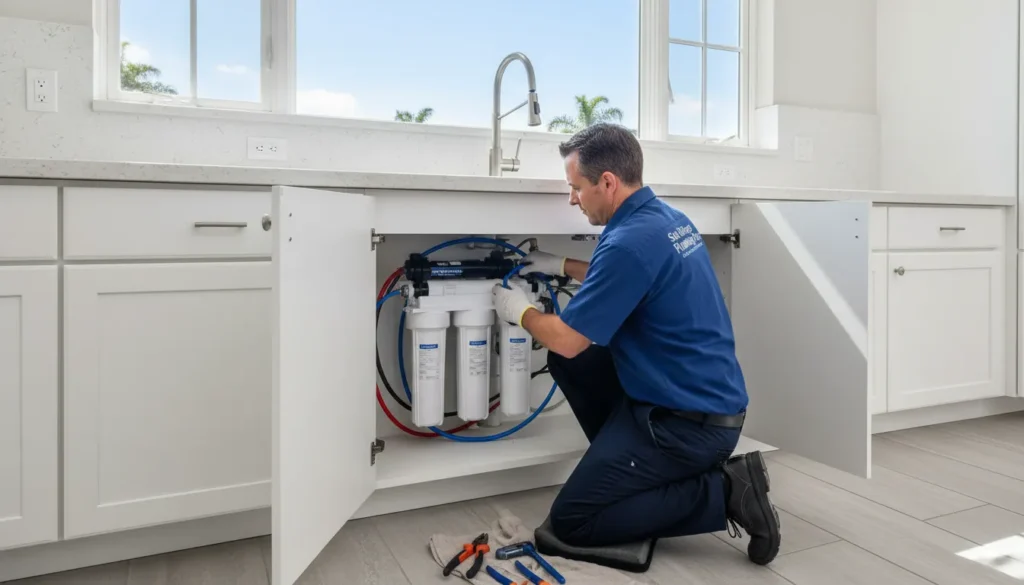
Point-of-use (POU) systems install at a specific fixture — most commonly under the kitchen sink or at a refrigerator line. They filter only the water at that outlet. POU systems deliver excellent drinking water quality but do nothing for the rest of your plumbing.
The most effective approach is both. A POE whole house system protects the infrastructure of your home. A POU system — typically a reverse osmosis unit — delivers the purest possible water for drinking and cooking. For a deeper look at what each system costs and what factors affect pricing, see our blog post on whole house water filtration system costs in San Diego.
Homes in La Jolla, Del Mar, Carmel Valley, and Rancho Santa Fe — where water quality and appliance longevity are a priority — frequently choose the combined approach.
What Professional Installation Involves
A professional whole house water filter installation requires cutting into your main water supply line, installing bypass valves, making secure connections, and verifying system performance. A licensed plumber handles all of this correctly the first time.
Here is what a typical installation looks like:
Pre-installation assessment. Your plumber identifies the best installation point on the main supply line, confirms there is adequate space for the filter housing and service access, and reviews the water chemistry to confirm the right system for your home.
Water shutoff. The main water supply is shut off at the meter or the main shutoff valve.
Line preparation. A section of the main supply line is cut and prepared to accept the filter housing, inlet and outlet fittings, and bypass valve assembly.
Filter housing installation. The housing is mounted securely, connections are made, and a bypass valve is installed. The bypass allows future filter changes without shutting off the whole house water supply.
System startup and leak check. Water is restored slowly and all connections are inspected for leaks. The system is flushed per manufacturer specifications.
Performance verification. Pressure and flow are confirmed at multiple fixtures to ensure the system is sized correctly and not creating a pressure drop. A pressure regulator installation is sometimes recommended at this stage if supply pressure is inconsistent.
Total installation time for a single-stage or two-stage system runs two to four hours in most San Diego homes. A multi-stage combination system may take four to six hours depending on the installation point and the existing plumbing configuration. Our residential plumbing team handles whole house filtration installations for homeowners across San Diego County.
Cost Breakdown: Whole House Water Filtration in San Diego
Filtration system costs vary based on the number of stages, the brand, and whether the installation requires additional plumbing work. Here are the general ranges for San Diego County:
Entry-level single-stage sediment or carbon filter Equipment: $200–$400 | Installation: $250–$400 | Total: $450–$800
Two-stage sediment + catalytic carbon system Equipment: $500–$900 | Installation: $300–$500 | Total: $800–$1,400
Three-stage whole house combination system (sediment + carbon + salt-free conditioner) Equipment: $900–$2,000 | Installation: $400–$700 | Total: $1,300–$2,700
Premium multi-stage systems with smart monitoring (e.g., Moen Flo integration) Equipment: $2,000–$4,000+ | Installation: $600–$1,000 | Total: $2,600–$5,000+
These ranges reflect equipment and labor. If the installation requires moving existing plumbing, adding a pressure regulator, or addressing a related issue identified during the assessment, costs adjust accordingly. For a full breakdown of filtration pricing including annual maintenance costs, see our blog post on whole house water filtration system costs in San Diego.
Repipe Home Hero provides free on-site estimates for whole house water filter installation across San Diego County. You know the exact cost before any work begins.
Maintenance Schedule: Keeping Your System Working
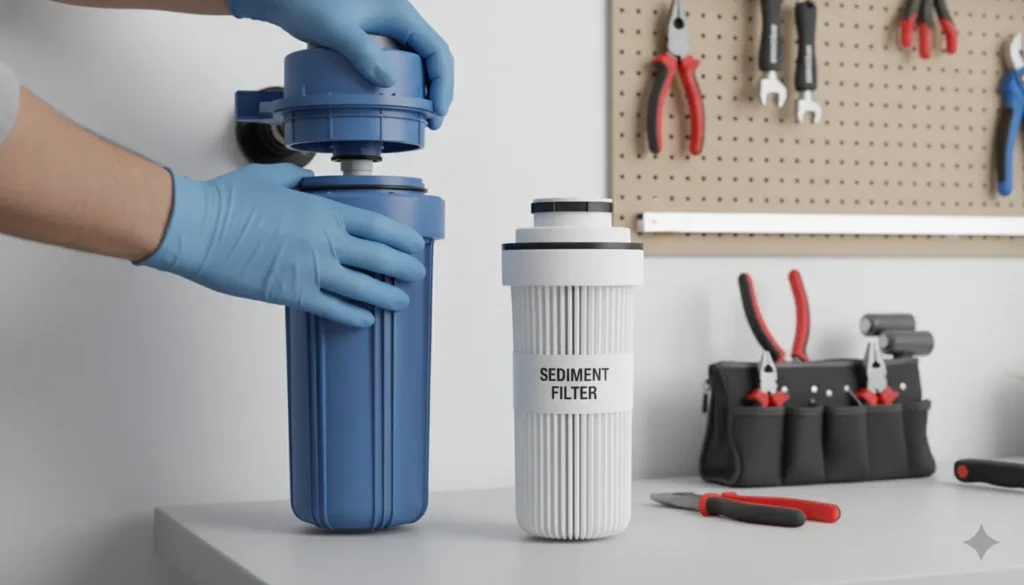
A whole house filter requires regular maintenance to perform correctly. A neglected filter provides no filtration.
Sediment pre-filter cartridge: Replace every 3–6 months, depending on your local water quality. Homes in areas with higher turbidity or sediment loads may need more frequent changes. A visual inspection — the cartridge turns from white to brown as it loads with particles — tells you when it needs replacement.
Carbon block filter cartridge: Replace every 6–12 months. Carbon media has a finite adsorption capacity. Once it is saturated, it no longer removes chloramines or organic compounds.
Salt-free conditioner media: TAC media typically lasts 3–5 years depending on the water volume processed. Some manufacturers rate media life by gallons treated.
Annual signs your filter needs attention:
- Return of chlorine/chloramine odor or taste in your water
- Scale reappearing on fixtures or in the water heater
- Visible sediment in the water or clogged aerators
- Reduced water pressure throughout the house
- Filter indicator light or pressure gauge alert (on equipped systems)
For a professional inspection and filter service, contact Repipe Home Hero. We also install and service Moen Flo smart water monitors, which track consumption patterns and can detect anomalies that signal a filter or plumbing issue before it becomes a damage event. If a water emergency occurs while you are evaluating filtration options, our emergency leak repair team is available across San Diego County.
Ready to Install a Whole House Water Filter in San Diego?
San Diego’s hard water and chloramine-treated supply make whole house filtration one of the most practical investments a homeowner can make. It protects your pipes, extends appliance life, improves water quality throughout the home, and pairs naturally with any recent plumbing upgrade.
Repipe Home Hero is a family-owned, C-36 licensed plumbing company serving San Diego homeowners in La Jolla, Del Mar, Carmel Valley, Rancho Santa Fe, Poway, Rancho Bernardo, Carlsbad, Encinitas, and communities throughout the county. We do not use subcontractors.
Request a free whole house water filtration estimate or call us at (619) 386-0375. We assess your home’s water, recommend the right system, and install it correctly the first time.
Also serving nearby: Poway | Del Mar | La Jolla | Rancho Santa Fe | Carmel Mountain Ranch | Encinitas