Water damage is one of the most expensive and disruptive things that can happen to a home. A pipe leaks behind a wall for weeks before anyone notices. A supply line fails under the kitchen sink while the family is on vacation. A slow drip near the water heater quietly turns a cabinet floor into a petri dish for mold. By the time most homeowners find out, the repair bill is well past what any of them budgeted for.
The Moen Flo Smart Water Monitor and Shutoff is a device designed to catch those problems before they become expensive ones. For San Diego homeowners — many of whom are managing aging copper pipes, hard water, and high-value properties — it has become one of the smartest additions a plumber can make to a home’s main water line.

What the Moen Flo Actually Is
The Moen Flo is a smart water security device that installs directly on your home’s main water supply line. It sits inline — meaning all the water entering your home flows through it — and uses three internal sensors to continuously monitor water flow rate, water pressure, and temperature. That data feeds into algorithms that learn your home’s normal usage patterns and flag anything that falls outside them.
The device connects to your home’s Wi-Fi and pairs with the Flo by Moen app on your smartphone. From the app, you can see live water usage, receive alerts, review your daily and monthly consumption, and — most importantly — shut off your home’s water supply remotely with a single tap.
Every night, the device runs what Moen calls a MicroLeak test: a low-flow health check that can detect drips as small as one drop per minute. These are the leaks most homeowners never find until there is already water damage, mold, or a spike on a utility bill.
Why San Diego Homes Are a Strong Fit for the Moen Flo
San Diego’s housing stock and water conditions make whole-home leak monitoring particularly valuable here compared to many other markets.

Aging copper pipes. A significant number of homes in La Jolla, Carmel Valley, Rancho Santa Fe, and Poway were built between the 1960s and 1990s with copper supply lines that are now reaching the end of their reliable service life. Copper pipes in San Diego age faster than in other regions because of the county’s hard water. According to the City of San Diego Public Utilities Department, tap water in San Diego averages 16 grains per gallon (276 ppm) — a hardness level that causes calcium scale buildup and pitting corrosion on the interior pipe wall. The Moen Flo detects the pressure irregularities and flow anomalies that pinhole leaks and thin pipe walls produce, often before a leak becomes visible.
High-value homes and vacation properties. Homes in Del Mar, Rancho Santa Fe, Fairbanks Ranch, and Solana Beach frequently sit empty for extended periods. A pipe failure that goes unaddressed for days or weeks can cause damage that runs into the tens of thousands of dollars. The Flo’s remote shutoff and app-based alerts mean a homeowner — or their property manager — can respond to an alert from anywhere and stop water flow to the house within seconds.
Hard water pressure spikes. San Diego homes with aging or incorrectly sized pressure regulators can experience intermittent pressure spikes that stress pipe joints, valves, and appliance connections. The Moen Flo monitors pressure in real time and sends alerts when readings fall outside safe parameters, giving homeowners an early signal that a regulator replacement may be needed before a joint fails.
How the Moen Flo Works: The Three-Sensor System
The device’s monitoring capability comes from three sensors working simultaneously.

Flow sensor. The flow sensor measures how much water is moving through the line and at what rate. It can distinguish between normal usage — a shower, the dishwasher, a running hose — and abnormal usage, like a fixture left running overnight or an unexpected flow when no one is using water.
Pressure sensor. Residential water pressure should stay within 40 to 80 PSI. Pressures above that range stress every connection in the home — shutoff valves, supply lines, appliance hoses, and pipe joints. The pressure sensor logs readings continuously and alerts the homeowner if pressure moves outside the normal band.
Temperature sensor. While San Diego homes are rarely at risk of frozen pipes, temperature data helps the Flo’s algorithms detect thermal anomalies near the main line and flag environmental conditions in the utility area where the device is installed.
These three data streams feed into FloSense Technology — Moen’s pattern recognition system — which learns what normal looks like for your specific household and identifies deviations that could indicate a leak, a running toilet, a burst pipe, or a failed appliance connection.
The Nightly MicroLeak Test
One of the most underappreciated features of the Moen Flo is the automated nightly health check. Each night, while the household is asleep, the device conducts a low-flow pressure test across the entire home’s plumbing system. It measures whether pressure holds steady with no water running. If there is even a slow drip anywhere downstream — behind a wall, under a slab, or inside a fixture — the pressure curve will show it.
This test catches leaks that a homeowner would never find on their own until visible damage appeared. For a La Jolla or Carmel Valley home with a copper pipe system that is 40 or 50 years old, catching a pinhole leak in its earliest stage — before it saturates insulation or framing — is the difference between a simple repair and a major remediation project.
Automatic Shutoff: What Happens When the Flo Detects a Problem
When the Flo’s algorithms identify a leak event — either through the nightly test or real-time flow monitoring — the app sends an alert to your phone. Depending on your settings, the device can also trigger an automatic shutoff of the main water supply without any action from the homeowner.
Automatic shutoff is the feature that makes the Moen Flo particularly valuable for unoccupied homes. A supply line failure at a vacation property in Rancho Santa Fe, if not caught quickly, can saturate flooring, saturate walls, and spread mold into structural cavities. With the Flo set to automatic shutoff mode, the water stops the moment the device detects an uncontrolled flow event — potentially limiting damage to minutes rather than days.

Moen Flo and Homeowners Insurance
Many homeowners insurance carriers recognize the Moen Flo as a risk reduction device and offer premium discounts to policyholders who install it. Farmers Insurance explicitly lists Moen Flo on their leak detection program page as a qualifying smart water monitor. According to Moen’s own documentation, the device reduces non-weather water claims by as much as 96 percent — a figure that underwriters at carriers like Farmers, State Farm, and Liberty Mutual factor into their risk models.
Some carriers — particularly for higher-value homes or homes with prior water damage claims — may require a smart water shutoff system as a condition of coverage renewal. For Rancho Santa Fe and Del Mar homeowners who have filed a water damage claim in recent years, installing the Flo can be the step that keeps their policy active.
After installation, Moen provides a verification letter that can be submitted to your insurance carrier to document the system and apply for any available discount. Your insurance agent is the best contact to confirm what your specific policy covers.
Where the Moen Flo Is Installed and What the Process Involves
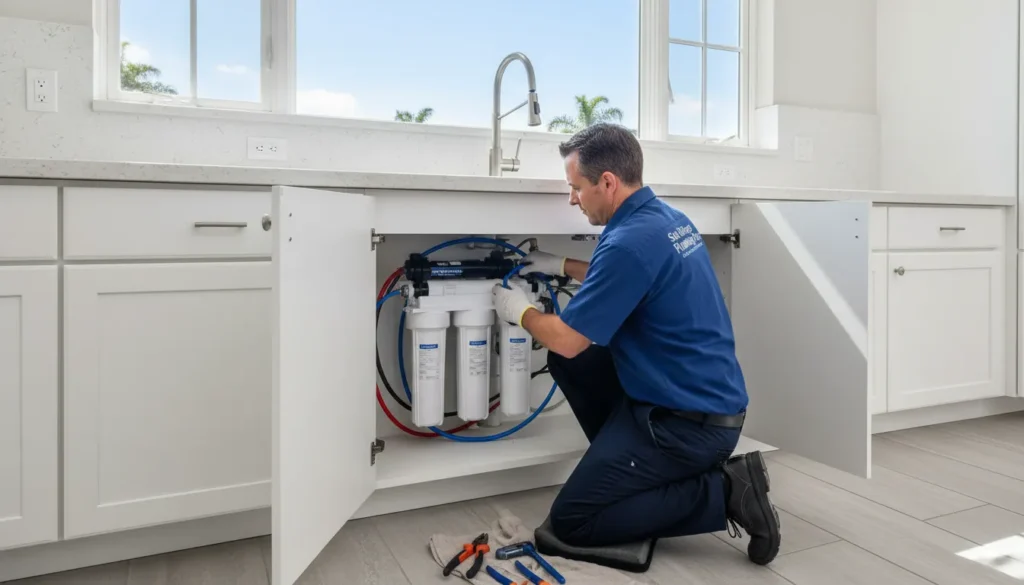
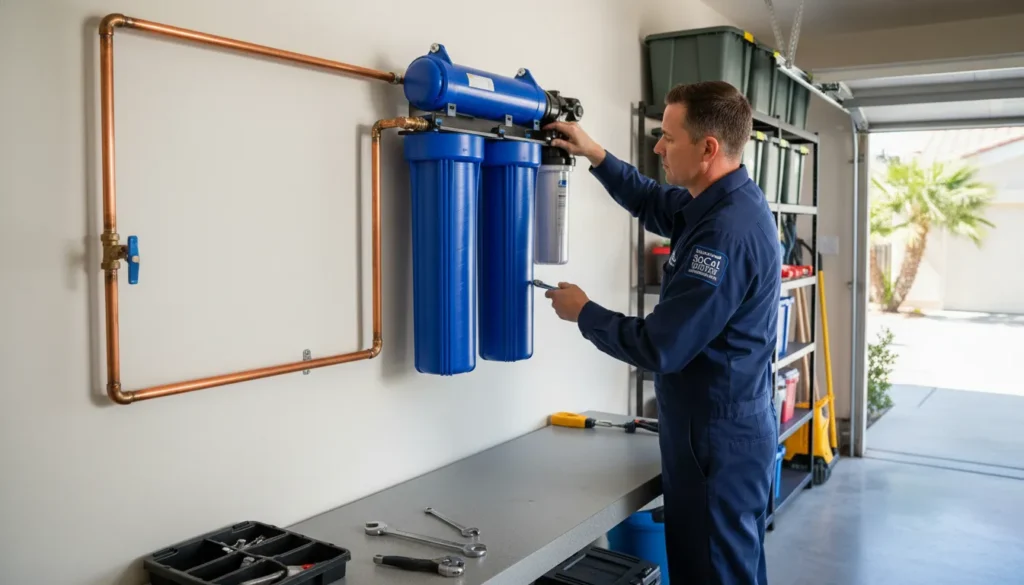
The Moen Flo installs on the home’s main water supply line — typically in the garage, at the meter, or in a utility room — after the water meter, main shutoff valve, and pressure regulator. A licensed plumber cuts a section of the main line and fits the device inline, connecting it to the existing pipe with the appropriate fittings for the line’s diameter. Most residential main lines are ¾-inch or 1-inch; the Flo is available in both sizes.

Installation typically takes 1 to 2 hours. There is a short period without water while the inline cut is made and the device is fitted. Once installed, the plumber confirms the connections are secure, restores water flow, checks for leaks at the fitting points, and walks the homeowner through connecting the device to Wi-Fi and setting up the app.
For homes that also have a whole-house repipe underway, the Flo is a natural addition at the end of the project — the new pipe system gets a smart monitor from day one, and the homeowner has a baseline dataset for pressure and flow that reflects brand-new pipes. Homeowners who have installed PEX repiping often add the Flo at the same time for exactly this reason.
If the home also has a whole-house water filtration system, the Flo is installed upstream of the filter so it monitors total incoming flow before any treatment equipment.
What the Moen Flo Does Not Cover
The Moen Flo monitors the water supply system from the main line inward. It does not monitor irrigation systems that branch off before the device’s installation point. It does not replace a pressure regulator — it alerts you to pressure problems, but a failing regulator must be replaced separately. And it does not prevent leaks that originate in drain lines, since drain systems carry waste water under gravity rather than pressurized supply.
For homeowners who want point-specific protection in addition to the main-line monitor — under sinks, near water heaters, or behind washing machines — Moen’s Smart Leak Detectors can pair with the Flo app and trigger the main shutoff when they detect moisture at a specific location.
Is the Moen Flo Worth It for Your San Diego Home?

For a home with aging pipes, high replacement value, or extended periods of vacancy, the answer is almost always yes. The device costs between $400 and $500 for the unit itself. Professional installation by a licensed plumber adds $150 to $300 depending on the complexity of the main line access. Some homeowners recover part or all of that cost through an insurance premium discount within the first policy year.
The harder math is the downside scenario: a single undetected pipe failure in a Poway or Escondido home can cause $20,000 to $50,000 in water damage — and that is before accounting for mold remediation, which can double the cost and complicate insurance claims significantly.
Matt Neal, a Repipe Home Hero customer, had the Flo installed alongside his repipe project. In his Google review, he noted the installation included “a new pressure regulator, smart shutoff valve, hot water recirculator pump, and whole house [water treatment]” — a combination that gave him both upgraded pipes and comprehensive monitoring from day one.
Schedule Your Moen Flo Installation in San Diego
Repipe Home Hero installs the Moen Flo Smart Water Monitor and Shutoff for homeowners across La Jolla, Carmel Valley, Rancho Santa Fe, Del Mar, Poway, Encinitas, and all of San Diego County. Every installation is performed by the same C-36 licensed team (License #1075463) that handles whole-house repiping, water heater installations, and emergency plumbing.
Schedule your free estimate or call (619) 386-0375. You can also learn more about our Moen Flo installation service and see what it includes for your specific home setup.
Related Resources
- Moen Flo Installation Service
- Whole-House Repipe
- Copper Repiping San Diego
- PEX Repiping San Diego
- Pressure Regulator Installation San Diego
- Whole-House Water Filter Installation
- Water Heater Installation San Diego