A pipe fails in your home. Water is on the floor, or you have spotted the stain on the ceiling, or a plumber has just found the source of the pressure drop you have been noticing for months. Now you have a decision to make: do you repair the damaged section, or do you replace the entire pipe system?
This is one of the most practical questions in residential plumbing, and the answer is not always obvious. Getting it right saves you money. Getting it wrong means you will be making the same call again in 18 months — except with more damage behind it.
When a Single Pipe Repair Makes Sense
Pipe repair is the right call under specific conditions. Not every leak signals a failing system, and not every homeowner needs a full repipe.
The home is relatively new. Homes built after 2000 with modern piping materials are good candidates for repair when a single failure occurs. These homes typically have copper, CPVC, or PEX systems that are not yet at the end of their service life. A single joint failure or a localized problem caused by physical damage — a nail through a wall, a frozen section, a faulty fitting — can be isolated and repaired without addressing the rest of the system.
The failure is at a specific, accessible joint or fitting. A compression fitting that has loosened, a section of pipe damaged during renovation work, or a single pinhole at a known stress point are all scenarios where repair makes technical and financial sense.
The rest of the system is in good condition. If a licensed plumber inspects the pipe system, finds no corrosion at other points, and the pipe material is sound throughout, a targeted repair is appropriate.
In these cases, a repair is not a band-aid — it is the correct solution. The distinction matters because unnecessarily replacing a healthy system wastes money and disrupts your home without benefit. Our residential plumbing service covers both repair and full replacement depending on what your home actually needs.
Warning Signs That a Repair Won’t Hold
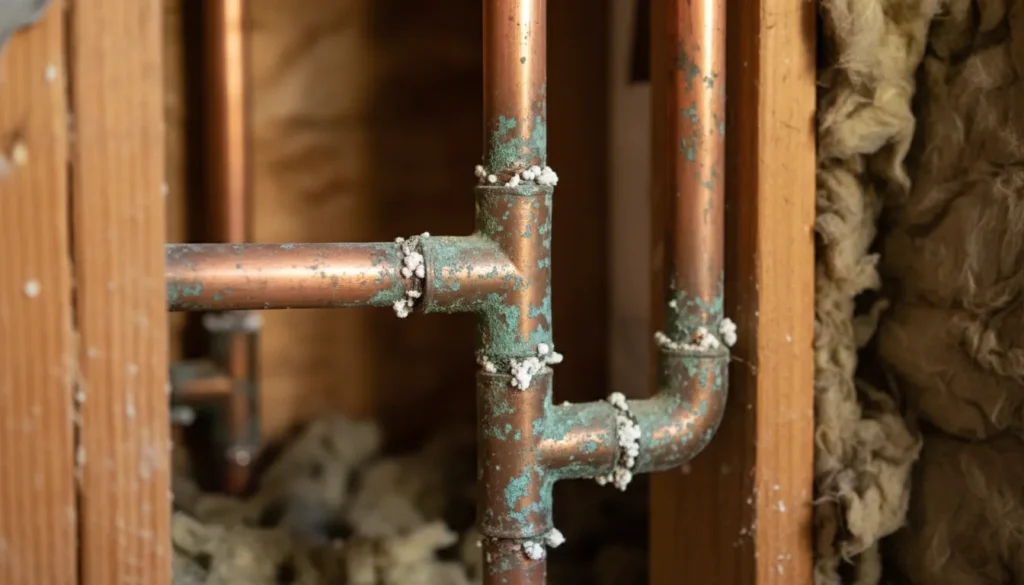
The more common scenario in San Diego is this: a homeowner experiences a leak, calls a plumber, gets it repaired, and then experiences another leak somewhere nearby within a year. That pattern is telling you something important about the condition of the pipe system as a whole.
Multiple leaks in the same pipe run. When pinhole leaks develop in more than one location in the same line, the corrosion is systemic. Hard water mineral buildup and internal oxidation have degraded the pipe wall along its length. Repairing one location does not address the damage progressing in adjacent sections.
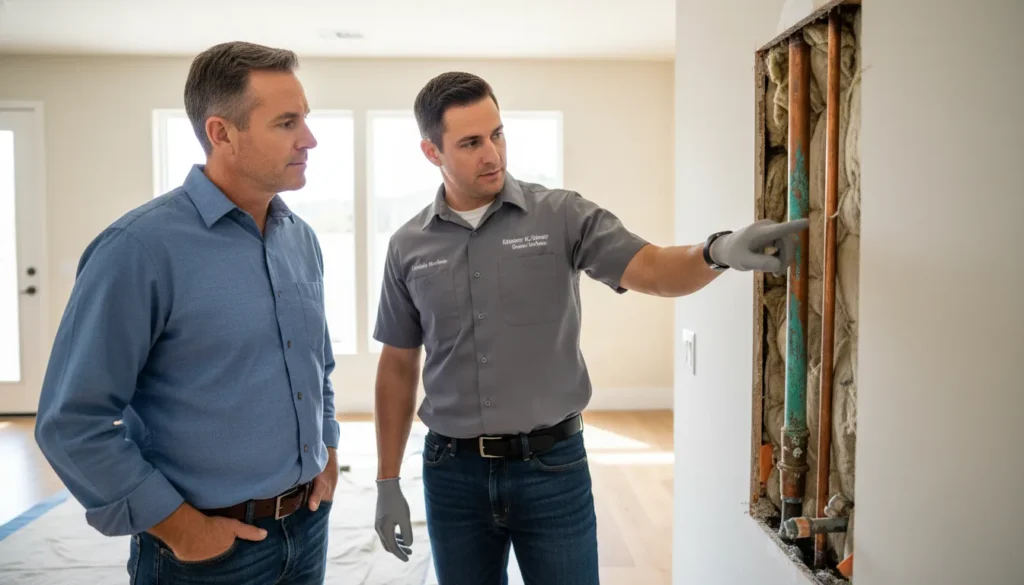
Visible corrosion at more than one point. If a plumber opens a wall and finds green staining (verdigris) on copper pipe at multiple access points, or rust buildup and scaling at several connections, that distribution of damage confirms the problem is not isolated. Research published in the EPA’s Science Inventory on copper pitting corrosion confirms that pitting corrosion in copper plumbing is a growing issue for homeowners — and that once established, it typically affects multiple points along the same pipe system.
Pipe age over 30 years. In San Diego County, homes built before the mid-1990s frequently have copper or galvanized steel pipe that is approaching or beyond its expected service life. For galvanized steel, failure accelerates after 30 to 40 years due to internal rust buildup. For copper in hard water environments, consistent pinhole leak development after 30 years indicates the material has degraded enough that continued patching is not a practical long-term approach. The San Diego County Water Authority documents that San Diego’s water supply — drawn largely from the Colorado River — carries high mineral content that accelerates this internal corrosion in aging pipes.
Recurring pressure loss across the home. If water pressure has dropped noticeably and no single obvious cause accounts for it, internal scale buildup throughout the system may be restricting flow. That is a whole-system condition, not a localized repair scenario.
When the pattern matches these warning signs, a whole house repipe eliminates the root cause rather than chasing individual failures. Read through our Why Repipe page for a straightforward breakdown of the factors that make full replacement the smarter financial decision.
The Financial Case: Repair Costs vs. Repipe Costs Over 5 Years
The cost conversation often leads homeowners to choose repair over repipe because the immediate repair bill is smaller. That logic is sound for a first repair on a relatively young home. For an aging system, the math works out differently.
A single pipe repair in San Diego typically runs between $200 and $600 for accessible failures and $800 to $1,500+ for leaks inside walls or under slabs. Those numbers look attractive compared to a whole-house repipe.
But consider the compounding cost: a typical aging home with systemic corrosion may develop two to four leak repairs within a three-to-five year window. Each repair visit carries a call-out fee, labor, and material cost. If any of those leaks cause water damage to drywall, flooring, or cabinetry, the remediation cost alone can exceed the cost of a full repipe.
Beyond direct repair costs, repeated leaks in the same home create documentation that affects insurance renewals, can complicate real estate transactions, and in severe cases trigger inspection-required repairs that must be completed before a sale proceeds.
Homeowners in Scripps Ranch, Carmel Mountain Ranch, Rancho Santa Fe, Del Mar, and La Jolla who have faced recurring leak cycles consistently report that the repipe cost — when viewed over a five-year window — was less than what continued patching would have totaled.
What a San Diego Pipe Repair Actually Involves
Understanding the repair process helps homeowners make an informed comparison.
Accessing the leak. Depending on location, the plumber cuts an opening in drywall, removes flooring sections above a slab, or accesses the pipe run from a crawl space or attic. Access difficulty directly affects repair cost.
Material matching. The repair section is cut out and replaced with matching material and compatible fittings. For copper systems, this means sweated copper connections. For PEX, mechanical fittings or crimp connections are used.
Pressure testing. After the repair, the system is pressurized to confirm the new connection holds before the access opening is closed.
Wall patch. The access opening in drywall is patched, textured to match, and painted if included in the scope of work.
For a simple repair on an accessible section, this process takes two to four hours. For slab access or complex multi-story layouts, the timeline extends accordingly.
If your situation involves a specific type of failure, our dedicated service pages go deeper on each scenario: pipe burst repair, emergency leak repair, pipe rerouting, and main water line repair.
Active Leak vs. Slow Seep: Knowing Which Response You Need
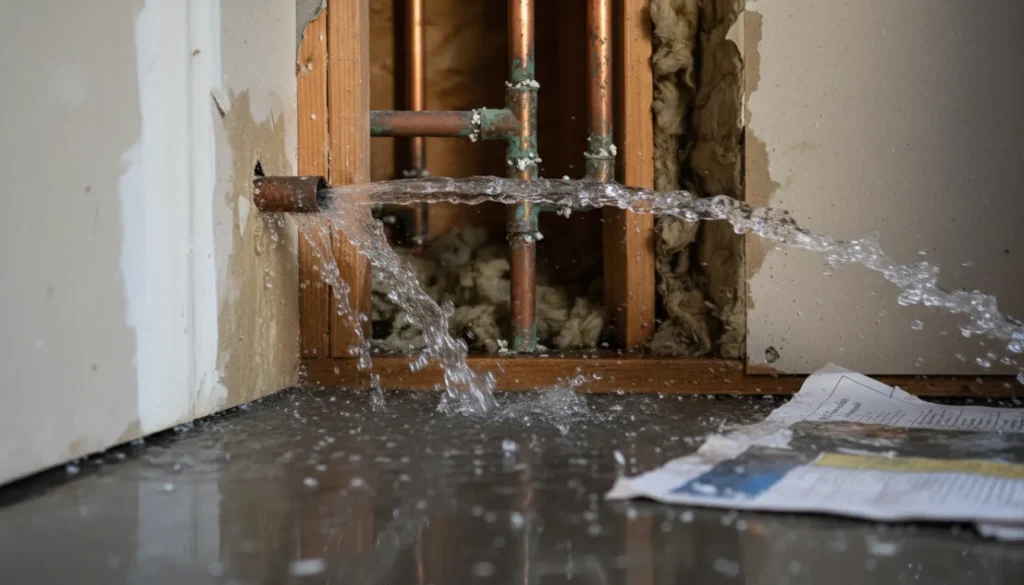
Not every pipe problem is an emergency. Understanding the difference between an active flood scenario and a slow, non-active seep helps you respond appropriately.
Active leak / burst pipe. Water is flowing from the pipe and cannot be stopped without shutting off the main water supply. Turn off the main shutoff valve (typically at the meter or in the garage in San Diego homes), call a licensed plumber, and do not restore water until the repair is complete. Repipe Home Hero offers emergency plumbing response across San Diego County at (619) 386-0375.
Non-active seep / slow leak. You notice a stain on the ceiling, soft drywall, a musty smell in a cabinet under the sink, or a water bill that has crept up without a clear reason. This situation is not immediately dangerous, but it warrants same-week service. A slow leak that goes unaddressed for weeks can cause significant mold growth and structural damage behind walls.
Pipe assessment vs. emergency callout. If you have recurring leaks or are planning a home sale, a scheduled pipe assessment is the right approach. A licensed plumber evaluates the full system, identifies deterioration before it becomes a failure, and gives you a complete picture of the pipe system’s condition.
For homeowners who also want to monitor their home’s water use after a repair or repipe, a Moen Flo smart water monitor can alert you to unusual flow patterns and stop the water supply automatically if a leak is detected.
Getting the Right Answer for Your Home
The question of repair versus repipe does not have a universal answer. It has a correct answer for your specific home, based on pipe material, age, leak history, and the findings of a professional assessment.
Repipe Home Hero serves homeowners across San Diego County. Our team inspects the full pipe system, explains what we find without pressure, and gives you a clear recommendation based on your home’s actual condition. Beyond repiping and pipe repair, we also offer a full range of plumbing services including water heater installation, pressure regulator installation, and water filtration systems.
We serve the full county — from La Jolla and Del Mar on the coast to Poway, Escondido, Vista, San Marcos, and Carlsbad further north and inland.
For emergency pipe repair, call (619) 386-0375. For a scheduled free repipe assessment, submit your information here. To learn more about our team and our track record across San Diego County, visit our About page.
Frequently Asked Questions
How do I know if my San Diego home needs a full repipe instead of a repair? If you have experienced more than one leak in the same pipe run, your pipes are over 30 years old, or a plumber finds corrosion at multiple locations during an inspection, a repipe is likely more cost-effective than continued repairs. A licensed plumber can give you a definitive assessment based on your home’s actual condition.
How much does pipe repair cost in San Diego? Accessible pipe repairs typically run $200 to $600. Repairs requiring wall access range from $600 to $1,500 or more depending on complexity. Slab leak repairs carry their own cost structure and vary significantly by access method.
Can I stay in my home during a whole house repipe? Yes. Water is restored the same day pipe installation is complete, so homeowners are not displaced during the project. Access openings are limited and covered with protective sheeting throughout.
What is the difference between pipe repair and pipe rerouting? Repair addresses the existing pipe at the failure point. Rerouting involves running new pipe through an alternate path to bypass a problematic section — often used when a slab repair would be too invasive or costly. Repipe Home Hero offers both repair and pipe reroute service in San Diego.
What should I do immediately when a pipe bursts in my San Diego home? Shut off the main water supply valve immediately to stop the flow. Then call a licensed plumber. Do not restore water until the repair is complete. Document any visible water damage with photos for insurance purposes.
Repipe Home Hero is a family-owned, C-36 licensed plumbing and repiping company serving all of San Diego County including La Jolla, Scripps Ranch, Rancho Bernardo, Poway, Carmel Mountain Ranch, Del Mar, Escondido, and Pacific Beach. C-36 Lic. #1075463.