You fill a glass at the kitchen tap and hold it up to the light. The water looks slightly hazy. Or you notice grit collecting at the bottom of your pot after boiling. Maybe your shower pressure has dropped and the aerator is clogged again. If you live in Poway — particularly in the 92064 zip code — you are dealing with a sediment problem, and you are not alone.
Cloudy or gritty water is not just unpleasant. Over time, sediment wears down appliances, clogs fixtures, and shortens the life of your water heater. Here is what causes it in Poway specifically, and what the right filtration solution looks like.
What Causes Sediment in Poway’s Water Supply

Poway’s water comes from a mix of local groundwater and imported supplies distributed through aging infrastructure managed by the Poway Municipal Water District. Several factors combine to push sediment into your home’s water.
Aging distribution mains: Many of Poway’s water distribution pipes were installed decades ago. As cast iron and steel mains corrode, they release rust particles and scale fragments into the supply. These particles travel with the flow and enter your home before any in-home filtration can stop them.
Seasonal turbidity from the Lake Poway watershed: During and after rain events, surface runoff increases turbidity in local water sources. The Lake Poway watershed collects water that eventually enters the treatment system, and seasonal spikes in sediment levels are common — particularly in winter and early spring. The U.S. Geological Survey defines turbidity as a measure of water cloudiness caused by suspended particles, and municipal systems can see measurable increases after storm events even after treatment.
Corroded service lines and home plumbing: In homes built before the 1980s — common in established Poway neighborhoods — galvanized steel pipes have had decades to rust from the inside out. Even if the municipal supply runs clean, sediment forms inside your own pipes before the water reaches the tap. This is a local problem that no amount of municipal treatment solves. If your home has galvanized pipes throughout, a conversation about whole house repiping in San Diego may be more cost-effective in the long run than layering filtration on top of corroding pipe.
Disturbances to the main line: Nearby construction, water main breaks, or pressure changes in the distribution system can dislodge sediment that has settled in pipes. Homeowners in Poway regularly report sudden bouts of discolored water following nearby utility work. These events are also a signal to check your home’s water pressure — pressure spikes from main line events can stress older plumbing components.
Types of Sediment Filters: Matched to Poway’s Profile

Not every sediment filter solves every problem. The right system depends on particle type, concentration, and your water usage.
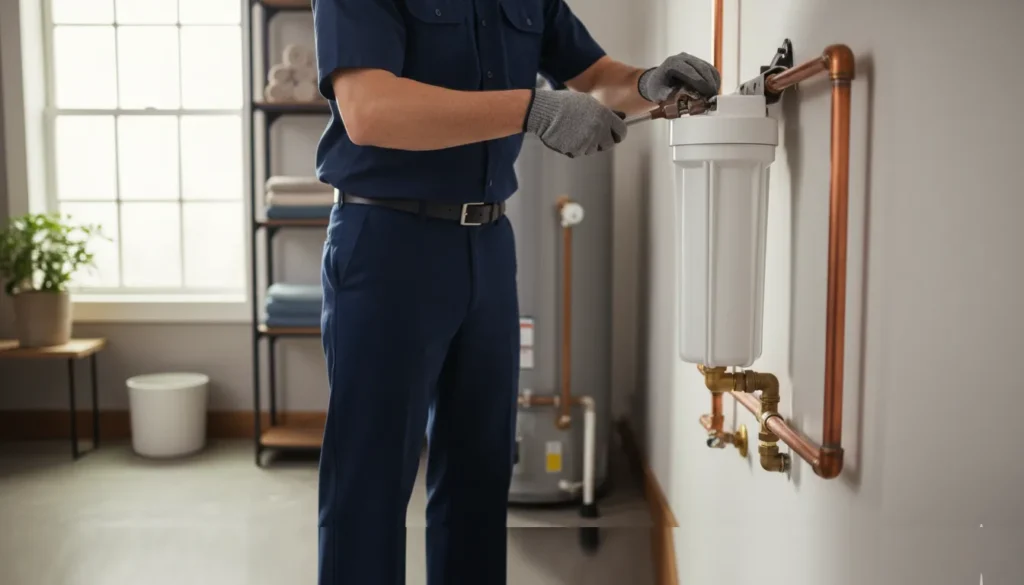
Spin-down sediment filters (50–1,000 microns) These whole-house pre-filters sit on the main supply line and use a screened cylinder to catch large particles — sand, gravel, rust flakes. They are easy to flush without replacing a cartridge and work well as a first-stage defense for Poway homes dealing with intermittent turbidity from main-line disturbances. They do not capture fine silt or dissolved iron.
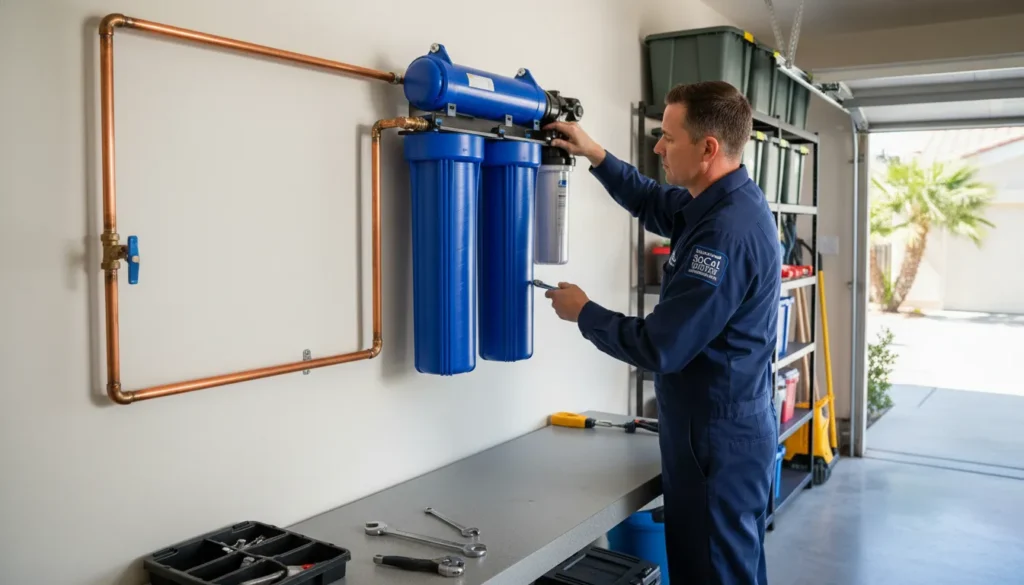
Cartridge sediment filters (1–50 microns) Cartridge filters trap finer particles than spin-down filters. They use replaceable filter elements — either pleated polyester or wound polypropylene — and can capture rust, silt, and fine sediment. For most Poway homeowners with moderately sediment-affected tap water, a 5-micron cartridge filter on the main line is the most cost-effective starting point.
Backwashing whole-house systems If your Poway home has a well, draws from a source with heavy mineral content, or shows consistently high sediment loads, a backwashing filter automatically flushes trapped sediment on a set schedule. These systems require no manual filter changes and handle high-volume sediment better than cartridge systems. They are a stronger fit for properties near Poway’s rural edges where soil intrusion through aging supply lines is more common.
The Water Quality Association maintains standards for residential water filtration equipment and is a reliable reference for evaluating filter certifications and performance ratings when comparing systems.
Sediment Filter vs. Full Filtration System
A sediment filter removes physical particles. It does not treat chlorine, chloramines, heavy metals, bacteria, or dissolved minerals. Here is how to decide what you need:
A sediment pre-filter alone is sufficient when:
- Your main concern is visible cloudiness, grit, or clogged aerators
- Your water otherwise tastes and smells acceptable
- You want to protect appliances and fixtures from abrasion
- You are protecting a downstream water softener or reverse osmosis system
A multi-stage system is the right choice when:
- Your water has a chemical smell or off taste alongside sediment
- You want to remove chlorine and chloramines from your household supply
- You are dealing with hard water and scale buildup in addition to turbidity
- You want drinking-quality water throughout the home, not just sediment removal
Poway’s water is classified as moderately hard, and many homeowners benefit from pairing a sediment pre-filter with a whole house water filtration system that addresses both particulates and chemical content. The cost breakdown for these systems is detailed in our guide to whole house water filtration system costs in San Diego.
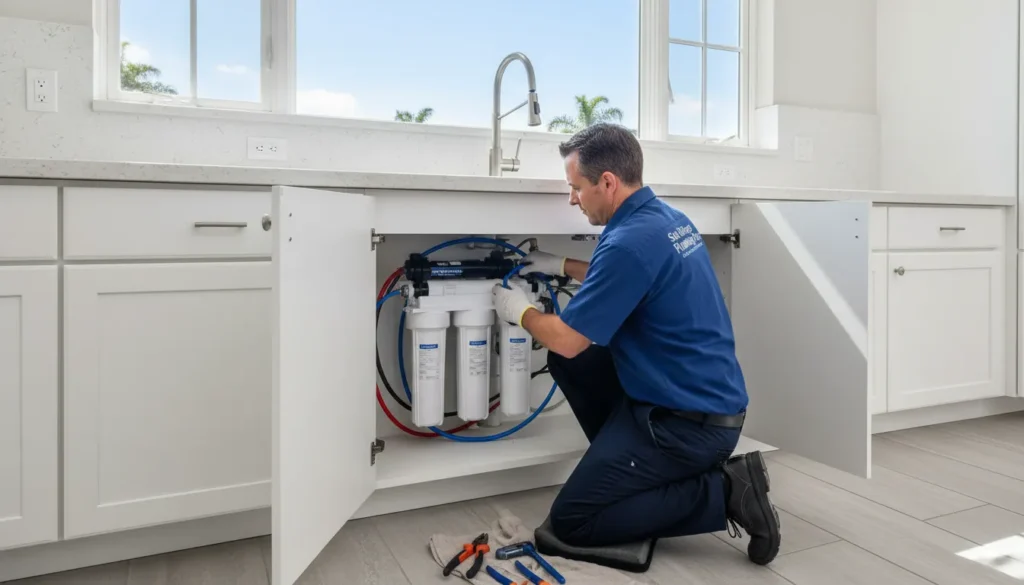
For drinking and cooking water specifically, a reverse osmosis system installed under the kitchen sink provides the highest level of purification. Read our full comparison: Reverse Osmosis vs. Whole House Water Filtration in San Diego. And if you are weighing sediment-only filtration against broader water quality treatment, our sediment filtration guide for San Diego covers both approaches side by side.
Installation and Maintenance: What to Expect

Installation time: A whole-house sediment filter installs on the main supply line, typically where it enters the home. Most installations take two to four hours. The plumber shuts off the main water supply, cuts into the supply line, fits the filter housing with appropriate fittings, and restores flow. No major drywall work is required in most Poway homes.
Filter change schedule:
- Spin-down filters: Flush monthly; no cartridge replacement needed
- 5-micron cartridge filters: Replace every 3 to 6 months depending on sediment load; homes near the 92064 rural fringe may need quarterly changes
- Backwashing systems: Set automated backwash cycle; no manual maintenance needed beyond annual inspection
Annual cost estimate:
- Spin-down filter: $0 to $20 per year (flushing only)
- Standard cartridge filter: $30 to $80 per year in replacement cartridges
- Backwashing system: $0 to $50 per year in water used during backwash cycles; higher initial installation cost
Initial installation costs: A single whole-house sediment cartridge filter installed by a licensed San Diego plumber typically runs $200 to $450 including parts and labor. Backwashing systems run $500 to $1,200 installed. Multi-stage systems that include carbon and sediment filtration start around $800 and range higher depending on system capacity. For a deeper cost breakdown on multi-stage systems, see our whole house water filter installation guide for San Diego.
Protecting Your Plumbing Beyond the Filter

Installing a sediment filter protects your home’s fixtures, water heater, and appliances from abrasive particles. But sediment often signals broader plumbing conditions worth addressing at the same time.
If your water heater is producing discolored water or rumbling sounds, sediment has likely accumulated in the tank. Repipe Home Hero handles water heater installation and replacement throughout the Poway area, including tankless systems that are not susceptible to sediment accumulation in the same way traditional tanks are. See our tankless water heater installation page for details.
For whole-home leak monitoring alongside your filtration upgrade, consider the Moen Flo Smart Water Monitor — a device that detects anomalous flow patterns and can alert you to supply line issues before they cause water damage.
Homeowners in Poway, Carmel Mountain Ranch, and Rancho Bernardo can explore all available plumbing and water quality services through our Poway plumbing services page or our plumbing services in Carmel Mountain Ranch. Additional questions about water filtration and home plumbing are answered on our FAQ page.
What Poway Homeowners Should Do Next
If your water looks cloudy, your fixtures are clogging early, or your appliances are showing scale buildup, a sediment filter is a practical and affordable solution. The right system for your Poway home depends on your water source, pipe age, and whether you want to address sediment only or improve overall water quality.
Repipe Home Hero installs sediment filters, whole house water filtration systems, and reverse osmosis systems throughout Poway and surrounding communities including Rancho Bernardo, Escondido, Scripps Ranch, Carmel Mountain Ranch, and 4S Ranch. Learn more about us or browse our full water filtration service offerings.
Contact us online or call (619) 386-0375 to schedule an on-site assessment. Find us on Google Maps or follow us on Facebook for local water quality tips.