Every San Diego homeowner with aging pipes eventually faces the same question: is it time to repipe, or can I keep patching? That question gets asked after the second leak repair. Or the third. Or when the water comes out yellow and the plumber shrugs and says, “It’s just old pipes.”
Here is the honest answer: if you are asking the question, the pipes are probably already telling you.
This guide walks through the six clearest signs your home needs repiping, the specific factors that accelerate pipe failure in San Diego, and how to think through the repair-versus-repipe math before you spend another dollar on a patch.

Sign 1: Low Water Pressure Throughout the House
Weak pressure at one faucet usually points to a local issue — a clogged aerator, a faulty shutoff valve, or a partially closed fixture. Weak pressure at multiple fixtures throughout the house is a different story.
Over time, hard water deposits and corrosion build up on the interior walls of supply pipes. The buildup narrows the pipe’s diameter and restricts flow. San Diego’s water consistently tests among the hardest in Southern California, with mineral concentrations that accelerate this process compared to cities with softer water supplies.
If your whole house feels like it is running at half pressure — showers, kitchen sink, and outdoor hose bibs included — the pipes are the most likely cause. In some cases, a failed pressure regulator is the culprit and can be replaced without a full repipe. A licensed plumber can determine which problem you have during an assessment.
Sign 2: Discolored or Rust-Tinted Water
Orange, brown, or reddish water is corroded pipe material entering your water supply. It happens when the protective oxide layer inside an aging copper or galvanized pipe breaks down and metal particles detach from the pipe wall.
Some homeowners see discoloration only in the morning — the first water drawn after sitting overnight in the pipes. Others see it throughout the day. Both are symptoms of the same underlying problem, with daily discoloration indicating greater severity.
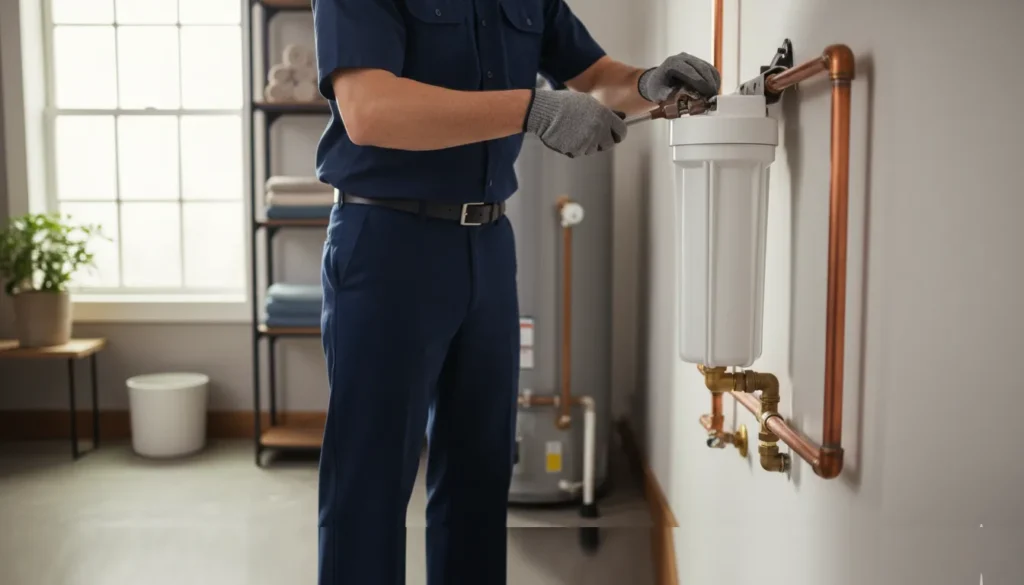
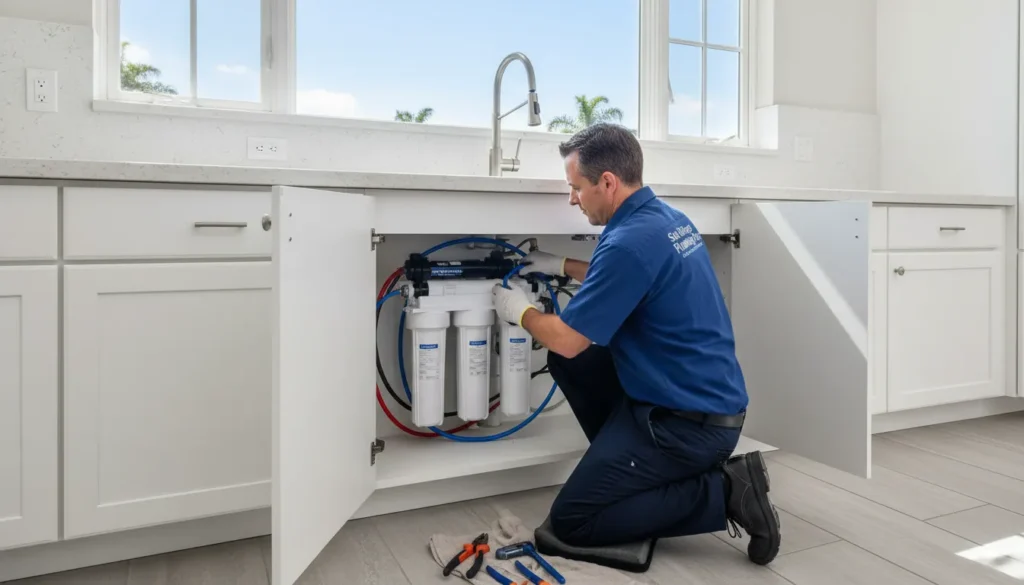
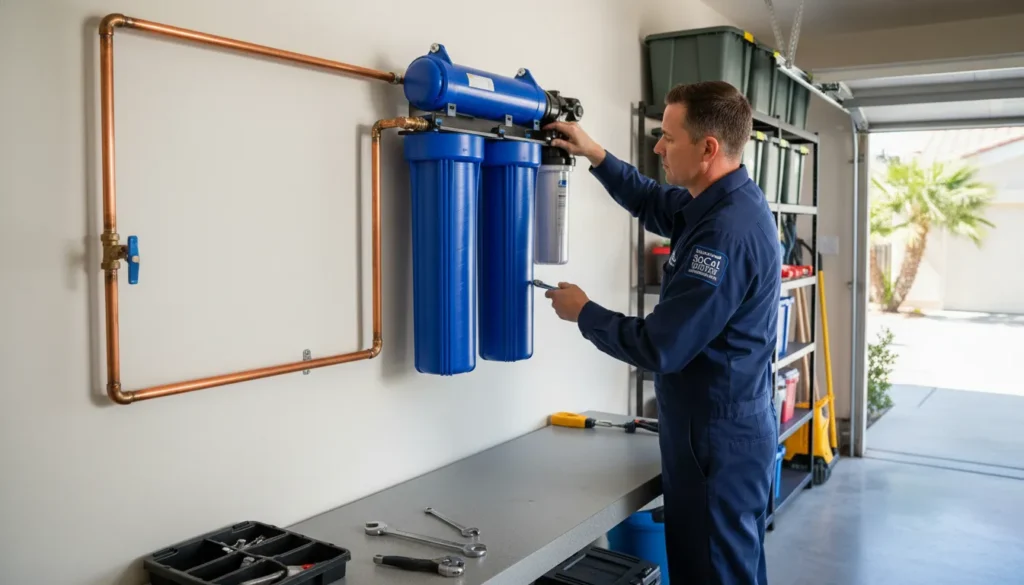
A whole house water filter or reverse osmosis system can improve water quality at the point of use, but neither addresses the pipe corrosion producing the contamination. If the water is visibly discolored, the pipes need to be evaluated for replacement.
The U.S. Environmental Protection Agency notes that corroded pipes can introduce lead and copper particles into drinking water, particularly in older homes where pipes have degraded past their useful service life.
Sign 3: Recurring Leaks
One pinhole leak on an otherwise sound pipe can be a fluke. Two or three leaks within a two-year period — especially at different locations — signal that the pipe material has degraded past the point where individual repairs are practical.
Pinhole leaks in copper pipes are typically caused by chlorine-driven pitting corrosion, a process accelerated by San Diego’s treated municipal water supply. Once pitting corrosion establishes itself across a copper pipe system, new leaks will continue to emerge regardless of how many prior repairs have been made.
An emergency leak repair addresses an individual failure. But when a pattern emerges across multiple locations, the conversation shifts from repair to replacement. Our why repipe page walks through how to evaluate that threshold in plain terms.
Sign 4: Polybutylene or Galvanized Pipes
Two pipe materials found in older San Diego homes have well-documented failure patterns and warrant replacement before leaks begin.
Galvanized steel was the standard supply pipe material in homes built before 1970. It corrodes from the inside out — slowly filling with rust, reducing water pressure year after year, and eventually failing at joints and elbows. Most San Diego homes with original galvanized supply lines built before 1975 are well past their expected 40-to-50-year service life.
Polybutylene is a gray plastic pipe installed in homes built between 1978 and 1995. It was the low-cost pipe material of its era and was widely used in San Diego County subdivisions throughout the 1980s. Chemical reactions with chlorinated water cause polybutylene to become brittle and crack from the inside. No reputable plumber will repair or extend a polybutylene system — only replace it.
If you do not know your pipe material, a licensed plumber can identify it during a free assessment. The Consumer Product Safety Commission has documented the widespread failure history of polybutylene pipe and its incompatibility with chlorinated water systems.
Sign 5: Pipes Older Than 40 Years
Age alone is not a reason to repipe. But age combined with San Diego’s specific conditions — hard water, clay-heavy soils in inland areas, and seasonal temperature swings at higher elevations — creates conditions that push pipes to failure faster than their design life suggests.
Homes built in the 1970s and early 1980s in communities like Mira Mesa, Clairemont, El Cajon, Chula Vista, and National City are now in the 40-to-55-year range. These homes were built during San Diego’s rapid suburban expansion and used construction-grade copper pipe thinner than residential copper installed in more recent decades.
If your home was built before 1985 and has never been repiped, a proactive assessment is worth scheduling. Repipe Home Hero serves homeowners throughout San Diego, Escondido, Vista, and San Marcos.
Sign 6: Slab Leak History
A slab leak occurs when a supply line beneath your home’s concrete foundation develops a leak. Repairing slab leaks is invasive and expensive — jackhammering through concrete, locating the precise leak point, making the repair, and patching the concrete.
A second slab leak on the same system is strong evidence the pipe material throughout the slab has degraded. A whole house repipe with pipe rerouting above the slab eliminates the risk of future slab failures entirely. Many San Diego homeowners who have had two or more slab leaks choose this approach as the final solution rather than continue repairing a system that will keep failing.
San Diego-Specific Risk Factors
San Diego’s environment creates specific pipe failure conditions that do not apply everywhere.

The region’s water supply is classified as moderately to very hard, with general hardness levels frequently between 200 and 400 parts per million depending on the service area. The U.S. Geological Survey identifies this range as a significant accelerant of mineral scale formation inside older residential supply lines.
Inland communities — including Santee, Spring Valley, Lakeside, and El Cajon — sit on expansive clay soils that shift with moisture changes. Ground movement exerts stress on rigid pipe materials, particularly copper, and can accelerate joint failure.
Coastal communities like La Jolla, Del Mar, and Solana Beach face a different risk: salt air and atmospheric moisture contribute to external corrosion where copper pipes run through uninsulated wall cavities near exterior walls.
Repair vs. Repipe: The Long-Term Math
The average cost of a single leak repair in San Diego ranges from $200 to $800, depending on access difficulty and repair type. Homeowners with aging pipe systems often average two to four repairs per year.

At two repairs per year at an average of $400 each, that is $800 annually — $4,000 over five years — with the underlying system continuing to deteriorate. At three to four repairs per year, five-year patch costs easily exceed $6,000 to $8,000. Those numbers also do not include water damage from a slow leak inside a wall: mold remediation, drywall replacement, and flooring repair.
A whole house repipe for a typical San Diego home runs $4,000 to $12,000 depending on size and pipe material. That is a one-time cost that eliminates the repair cycle, improves water pressure and quality, and adds documented value to your property.
What to Ask a Repiping Contractor
Before hiring any plumbing company for a whole house repipe, ask these questions directly.
What is your C-36 license number? In California, whole house repipe work requires a C-36 Plumbing Contractor license. Repipe Home Hero holds C-36 License #1075463.
Do you pull permits? A permitted repipe is inspected by the city and documented on your property record. Unpermitted plumbing work creates liability and complicates home sales. Always require permits.
What pipe material do you recommend, and why? A trustworthy contractor explains the trade-offs between copper and PEX-A for your specific home rather than defaulting to the cheapest or most convenient option.
Does the price include drywall repair? Some contractors quote pipe labor only and leave you to hire a separate drywall crew. Repipe Home Hero includes drywall repair and texture matching in the project scope.
For more questions answered, visit our FAQ page.
Book a Free Assessment

Related Services:
- Whole House Repipe San Diego
- PEX Repiping San Diego
- Copper Repiping San Diego
- Pipe Reroute San Diego
- Emergency Leak Repair
- Whole House Water Filter Installation
- Reverse Osmosis Installation
- Pressure Regulator Installation
- Main Water Line Repair
- Why Repipe?
- View All Services