“But it’s still working fine.” That is usually the first thing a homeowner says when a technician points out their water heater is already past its expected lifespan. A unit can run normally right up until the week it doesn’t, and the gap between “still working” and “already overdue” is often bigger than most people assume.
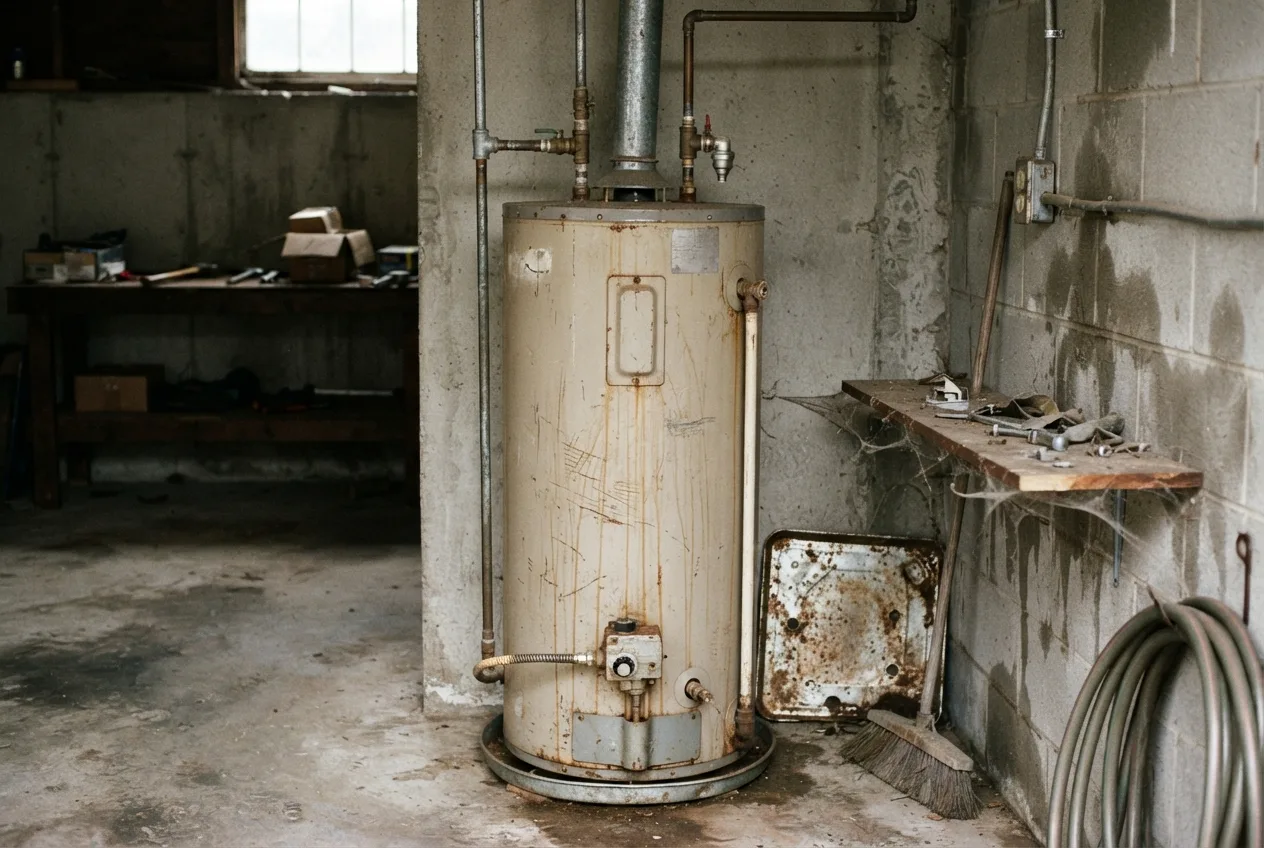
Typical Lifespan by Water Heater Type
Standard tank water heaters are generally rated for 8 to 12 years. San Diego’s hard water pushes many local units toward the shorter end of that range, since mineral buildup inside the tank accelerates both sediment accumulation and corrosion of the interior lining faster than it would in an area with softer water.
Tankless water heaters typically last 20 years or more, since there is no tank to corrode and the unit only engages when water is actually flowing. Periodic descaling, especially given San Diego’s water hardness, keeps a tankless unit closer to the higher end of that range.
Hybrid heat pump water heaters generally fall in a similar range to standard tanks, around 10 to 15 years, though the compressor component is a mechanical part with its own wear pattern separate from the tank itself.

A Working Unit Isn’t the Same as a Healthy One
A water heater nearing the end of its expected life often behaves almost normally right up until it doesn’t. Recovery time might be slightly slower than it used to be. The tank might run a little louder. None of this necessarily looks like failure, which is exactly why age itself, not just symptoms, matters as a signal. A unit that is 11 years old and currently working fine is a fundamentally different risk than a unit that is 4 years old and working fine, even though both would pass a casual glance. If you’re not sure which category your unit falls into, a quick assessment settles it.
When Proactive Replacement Makes More Sense Than Waiting
If your unit is within 2 to 3 years of the upper end of its expected lifespan, replacing it on your own schedule is usually the better financial call, even without an obvious symptom pushing you toward it. The reasoning is straightforward: the unit is going to need replacement eventually regardless, and doing it proactively means you control the timing, the budget, and the installation date, rather than reacting to a failure that picks its own moment.
This matters more for a tank unit than a tankless one, since a failing tank can leak and cause water damage as part of its failure, while a tankless unit is more likely to simply stop producing hot water without the same flooding risk.
Cost: Planned Replacement vs. Emergency Replacement
A planned replacement, scheduled when it is convenient for you, generally runs $1,800 to $3,500 for a standard tank or $3,500 to $6,500 for a tankless system. The unit cost for an emergency replacement is similar, but the real difference shows up elsewhere: potential water damage if a tank fails and leaks before anyone notices, the inconvenience of going without hot water until a technician can fit you into an already-booked schedule, and sometimes a rushed decision made under pressure rather than a considered one. Proactive replacement trades a small amount of “it still works” value for control over when and how the project happens.

Why San Diego Homeowners Choose Repipe Home Hero
Repipe Home Hero tracks unit age and condition during every service visit, not just the ones specifically about the water heater. That means you get a heads-up when your unit is approaching the end of its expected life, rather than finding out only after something fails.
Owner Stefan Mirkov holds a California C-36 plumbing license (#1075463), and every visit is handled by Repipe Home Hero’s own licensed crew, without subcontracted labor. Repipe Home Hero has completed more than 950 projects across San Diego County and holds over 250 five-star Google reviews.
Frequently Asked Questions
Does regular maintenance meaningfully extend a water heater’s life? Yes. Annual tank flushing removes sediment before it hardens and causes lasting damage, and periodic anode rod inspection catches corrosion before it reaches the tank’s steel lining. A well-maintained unit often reaches the higher end of its expected lifespan range, while a neglected unit in a hard water area like San Diego tends to fail closer to the lower end, sometimes years earlier than expected.
How do I know if my water heater’s age alone is a reason for concern? If your standard tank unit is past 10 years old, age alone is worth factoring into your decision, even without obvious symptoms. A tankless unit generally does not need the same proactive concern until it approaches 18 to 20 years, given its longer expected lifespan.
Is it worth replacing a water heater that still works, just because of its age? It depends on how close the unit is to the end of its expected range. A unit at 6 or 7 years with no symptoms has real life left. A unit at 11 or 12 years, even one that seems fine, carries meaningfully higher failure risk, and proactive replacement at that point is a reasonable way to avoid an emergency.
Do tankless water heaters really last twice as long as tank units? Generally, yes. Tankless units commonly reach 20 years or more, compared to 8 to 12 years for a standard tank, largely because there is no large steel tank to corrode. Regular descaling in a hard water area like San Diego helps a tankless unit reach the longer end of that range.
Schedule a Free Lifespan Assessment
Not sure where your water heater stands? Repipe Home Hero offers a free lifespan assessment for San Diego County homeowners who want a clear answer before a symptom forces the decision.
Call (619) 386-0375 or book your free assessment online today.
Learn more about our water heater installation services, our tankless water heater options, or read our related guide on tank vs. tankless water heaters in San Diego to compare both paths in more depth. If you’re noticing early warning signs already, see our guide on signs your water heater is failing.